Office refurbishment helps decision-makers protect the condition, safety and day-to-day usability of a working property. For busy office workplaces, the practical aim is to identify priorities, plan appropriate work and keep clear records without creating unnecessary disruption.
What Office refurbishment involves
Office refurbishment is not a single task. It brings together the checks, planning and follow-up needed to keep a property suitable for its intended use. The exact scope depends on the building, its occupants, operating hours and any issues already identified.
Effective Office refurbishment starts with a realistic view of the building’s current condition and the people who rely on it.
A useful starting point is to separate urgent risks from planned improvements. This gives managers a clearer order of work and makes it easier to explain decisions to occupiers, contractors and stakeholders.
In practice, Office refurbishment works best when the scope is clear before work is booked. That means defining the outcome, the areas affected and the records needed after completion.
Key areas to review
- workplace refurbishment
- office renovation planning
- commercial office upgrade
- workspace improvement
These areas should be reviewed in the context of the property rather than treated as a generic checklist. For example, a site open to customers may need work planned around trading hours, while a managed building may need clear communication with tenants before access is arranged.
Regular Office refurbishment reviews also make it easier to spot patterns. Repeated faults, missed checks or unclear responsibilities should be addressed before they become a wider operational issue.
A practical process
- Assess the current condition. Record the issue, location, likely impact and any immediate safety concerns.
- Prioritise the work. Deal with urgent hazards first, then schedule work that can be completed safely and efficiently.
- Set a clear scope. Confirm what is included, what access is required and how completion will be checked.
- Keep a record. Retain relevant photographs, reports, quotations and completion notes for future decisions.
Choosing the right approach
The right approach balances condition, cost, timing and the effect on the people using the building. A low-cost short-term repair may be appropriate for a minor issue. However, where the same issue recurs, a more durable solution can be easier to manage and may reduce repeated disruption.
A well-planned Office refurbishment decision therefore considers both today’s problem and the likely next step. This helps avoid treating every issue as isolated when a coordinated plan would be more suitable.
| Situation | Useful response |
|---|---|
| Immediate risk or loss of use | Make the area safe, document the issue and arrange an appropriate response. |
| Recurring defects | Review the underlying cause before authorising another temporary repair. |
| Planned upgrade | Define the outcome, budget, access needs and completion standard before work begins. |
How professional support can help
When several workstreams need coordinating, professional property support can help turn individual tasks into an organised plan. The value is in clear communication, sensible sequencing and a record of what was agreed and completed. Office refurbishment support should also make responsibilities and next actions easy to understand. [INTERNAL LINK: relevant Gohaych service page]
Questions to ask before proceeding
- What problem is being solved, and what evidence supports that decision?
- How will the work affect occupants, customers or normal operations?
- What approvals, access arrangements or records are needed?
- How will quality and completion be checked?
These questions keep Office refurbishment focused on a useful outcome rather than a list of disconnected tasks.
Frequently asked questions
How often should this be reviewed?
Review frequency should reflect the building, its use and the nature of the issue. High-use or higher-risk areas usually need more regular attention than low-use areas.
Can work be completed while the property is occupied?
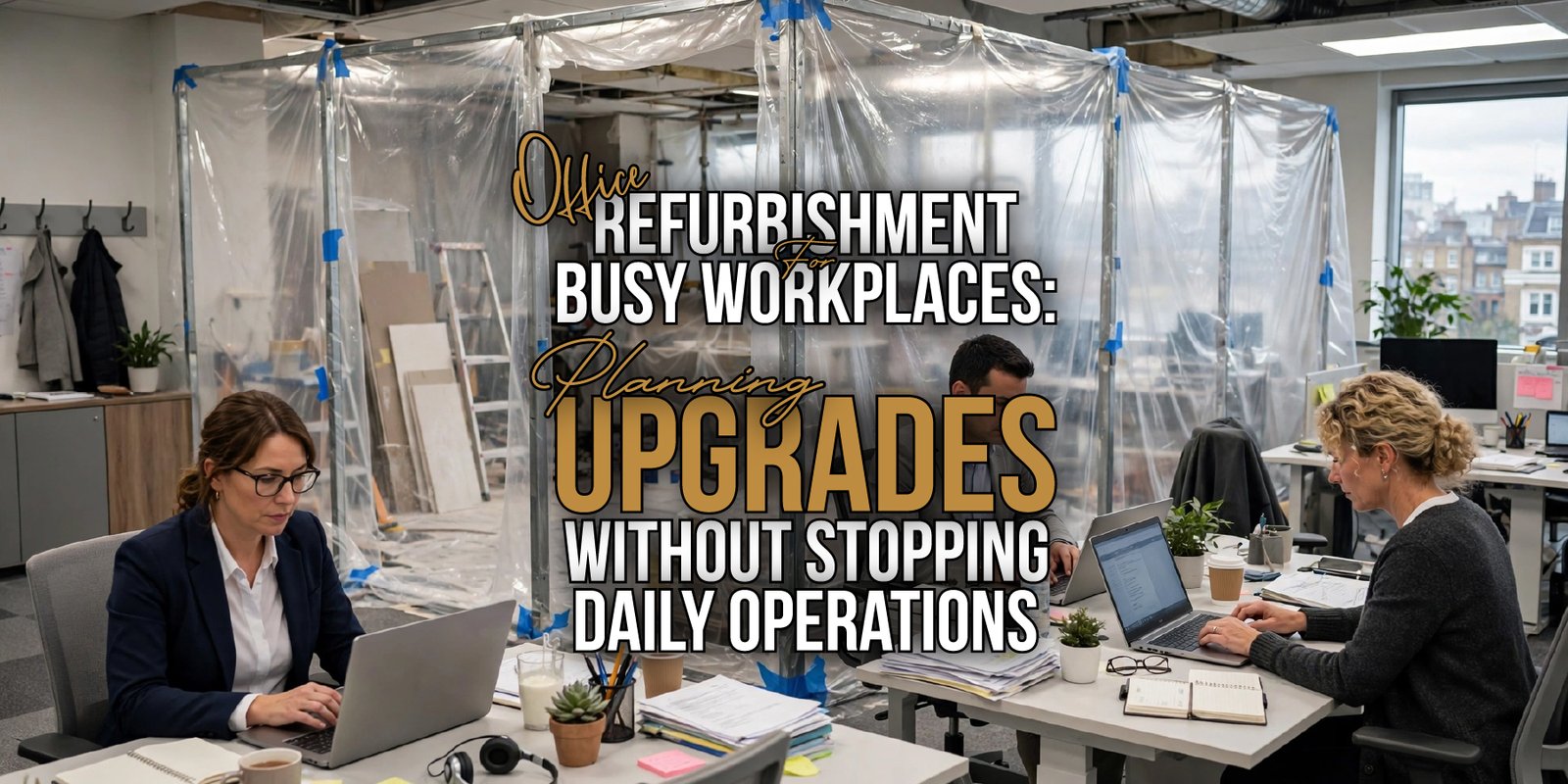
Often, yes. The work should be planned around access, safety, noise, dust, security and the needs of the people using the space.
What records are useful?
Keep a clear scope, quotations, photographs where appropriate, reports, completion notes and any relevant maintenance history.
Next steps for Office refurbishment
Start with a clear picture of the property, the outcome required and the constraints that matter. Then use that information to decide whether the work needs an immediate response, a planned programme or a wider improvement project. A documented Office refurbishment plan gives everyone a clearer route from issue to completion. Discuss your property requirements with Gohaych Services.
Set the brief before scheduling work
A clear Office refurbishment brief gives everyone the same starting point. It should identify the area involved, the outcome required, the operating constraints and the evidence that will show the work is complete. This avoids vague requests that lead to inconsistent pricing, avoidable visits or uncertainty about responsibility.
Before approving work, ask what will happen if the issue is left unresolved, what access is needed and whether nearby activities could be affected. Good Office refurbishment planning also considers safety, security, cleaning, noise, deliveries and the availability of key people. Those details are often small individually; together, they determine whether work runs smoothly.
Where several issues compete for attention, use a simple priority order: immediate risk, loss of function, recurring defect, planned improvement and cosmetic work. This makes Office refurbishment easier to explain and helps managers allocate time without losing sight of the longer-term condition of the property.
At this stage, record the decision and the reason for it. A short written note can prevent confusion later, especially where priorities, access or scope need to change.
Plan around the people using the building
A clear Office refurbishment brief gives everyone the same starting point. It should identify the area involved, the outcome required, the operating constraints and the evidence that will show the work is complete. This avoids vague requests that lead to inconsistent pricing, avoidable visits or uncertainty about responsibility.
Before approving work, ask what will happen if the issue is left unresolved, what access is needed and whether nearby activities could be affected. Good Office refurbishment planning also considers safety, security, cleaning, noise, deliveries and the availability of key people. Those details are often small individually; together, they determine whether work runs smoothly.
Where several issues compete for attention, use a simple priority order: immediate risk, loss of function, recurring defect, planned improvement and cosmetic work. This makes Office refurbishment easier to explain and helps managers allocate time without losing sight of the longer-term condition of the property.
At this stage, record the decision and the reason for it. A short written note can prevent confusion later, especially where priorities, access or scope need to change.
Compare short-term repairs with lasting work
A clear Office refurbishment brief gives everyone the same starting point. It should identify the area involved, the outcome required, the operating constraints and the evidence that will show the work is complete. This avoids vague requests that lead to inconsistent pricing, avoidable visits or uncertainty about responsibility.
Before approving work, ask what will happen if the issue is left unresolved, what access is needed and whether nearby activities could be affected. Good Office refurbishment planning also considers safety, security, cleaning, noise, deliveries and the availability of key people. Those details are often small individually; together, they determine whether work runs smoothly.
Where several issues compete for attention, use a simple priority order: immediate risk, loss of function, recurring defect, planned improvement and cosmetic work. This makes Office refurbishment easier to explain and helps managers allocate time without losing sight of the longer-term condition of the property.
Useful related reading: office refurbishment planning · commercial refurbishment costs and timing · commercial property upgrade ideas.
Use records to make better decisions
A clear Office refurbishment brief gives everyone the same starting point. It should identify the area involved, the outcome required, the operating constraints and the evidence that will show the work is complete. This avoids vague requests that lead to inconsistent pricing, avoidable visits or uncertainty about responsibility.
Before approving work, ask what will happen if the issue is left unresolved, what access is needed and whether nearby activities could be affected. Good Office refurbishment planning also considers safety, security, cleaning, noise, deliveries and the availability of key people. Those details are often small individually; together, they determine whether work runs smoothly.
Where several issues compete for attention, use a simple priority order: immediate risk, loss of function, recurring defect, planned improvement and cosmetic work. This makes Office refurbishment easier to explain and helps managers allocate time without losing sight of the longer-term condition of the property.
At this stage, record the decision and the reason for it. A short written note can prevent confusion later, especially where priorities, access or scope need to change.
Coordinate contractors and access carefully
A clear Office refurbishment brief gives everyone the same starting point. It should identify the area involved, the outcome required, the operating constraints and the evidence that will show the work is complete. This avoids vague requests that lead to inconsistent pricing, avoidable visits or uncertainty about responsibility.
Before approving work, ask what will happen if the issue is left unresolved, what access is needed and whether nearby activities could be affected. Good Office refurbishment planning also considers safety, security, cleaning, noise, deliveries and the availability of key people. Those details are often small individually; together, they determine whether work runs smoothly.
Where several issues compete for attention, use a simple priority order: immediate risk, loss of function, recurring defect, planned improvement and cosmetic work. This makes Office refurbishment easier to explain and helps managers allocate time without losing sight of the longer-term condition of the property.
At this stage, record the decision and the reason for it. A short written note can prevent confusion later, especially where priorities, access or scope need to change.
Review quality before signing work off
A clear Office refurbishment brief gives everyone the same starting point. It should identify the area involved, the outcome required, the operating constraints and the evidence that will show the work is complete. This avoids vague requests that lead to inconsistent pricing, avoidable visits or uncertainty about responsibility.
Before approving work, ask what will happen if the issue is left unresolved, what access is needed and whether nearby activities could be affected. Good Office refurbishment planning also considers safety, security, cleaning, noise, deliveries and the availability of key people. Those details are often small individually; together, they determine whether work runs smoothly.
Where several issues compete for attention, use a simple priority order: immediate risk, loss of function, recurring defect, planned improvement and cosmetic work. This makes Office refurbishment easier to explain and helps managers allocate time without losing sight of the longer-term condition of the property.
At this stage, record the decision and the reason for it. A short written note can prevent confusion later, especially where priorities, access or scope need to change.
Build a practical programme for the next review
A clear Office refurbishment brief gives everyone the same starting point. It should identify the area involved, the outcome required, the operating constraints and the evidence that will show the work is complete. This avoids vague requests that lead to inconsistent pricing, avoidable visits or uncertainty about responsibility.
Before approving work, ask what will happen if the issue is left unresolved, what access is needed and whether nearby activities could be affected. Good Office refurbishment planning also considers safety, security, cleaning, noise, deliveries and the availability of key people. Those details are often small individually; together, they determine whether work runs smoothly.
Where several issues compete for attention, use a simple priority order: immediate risk, loss of function, recurring defect, planned improvement and cosmetic work. This makes Office refurbishment easier to explain and helps managers allocate time without losing sight of the longer-term condition of the property.
At this stage, record the decision and the reason for it. A short written note can prevent confusion later, especially where priorities, access or scope need to change.
Making the final decision
Before work begins, confirm the decision in writing. A useful record states the problem, the agreed scope, the responsible contact, any access arrangements, the expected completion date and the method for checking the result. It also records assumptions that could affect the cost or timing, such as hidden defects, restricted access or work that depends on another contractor.
This final check is where Office refurbishment becomes practical rather than theoretical. It gives owners, occupiers and contractors a shared point of reference if the work changes once it is underway. Where a quotation presents more than one option, compare the likely service life, disruption, maintenance needs and limitations instead of relying on the headline price alone.
After completion, review what was learned. If a repair, check or upgrade exposed a wider issue, feed that information into the next plan. Over time, this makes Office refurbishment more consistent, easier to budget for and more useful to the people responsible for the property.